By Jonathan Edelman
For years, people have debated whether artificial intelligence would become useful to everyday life. That debate is now over
The real question today is not whether AI matters — it’s how much value it is already creating for humanity behind the scenes.
Most people still think of AI as something futuristic. Robots. Science fiction. Job replacement. Fear. But the truth is much simpler and far more interesting: millions of people are already quietly using AI every single day because it helps them save time, reduce stress, learn faster, solve problems, and improve their lives.
A recent economic study by researchers from Stanford, Carnegie Mellon, and other institutions attempted to measure something extremely important: how much generative AI tools are actually worth to ordinary people.
Instead of measuring corporate profits, they looked at human value.
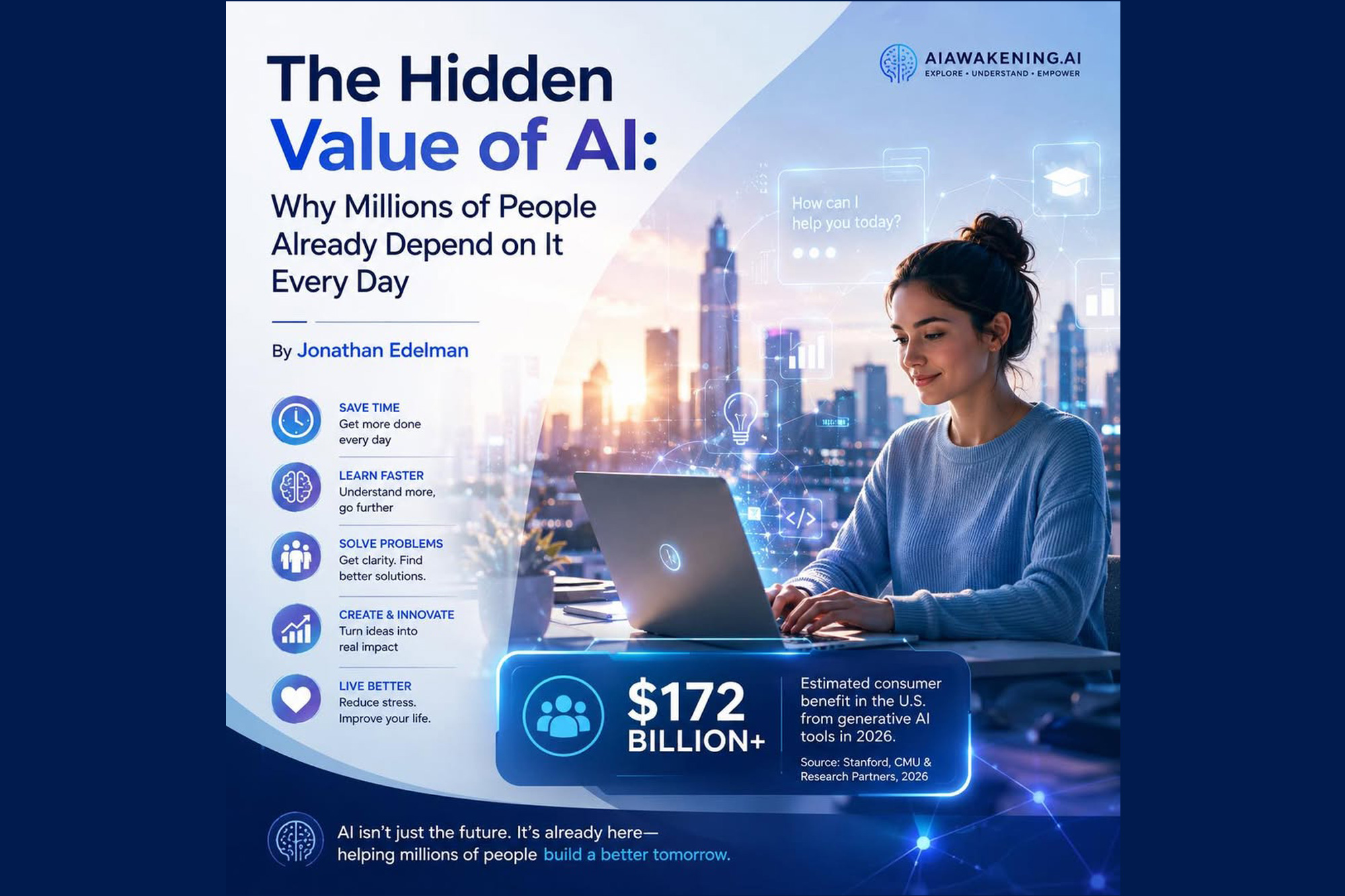
Researchers asked Americans how much money they would need to be paid in order to give up AI tools like ChatGPT, Gemini, Claude, or Copilot for one month. The answers revealed something surprising. Many users valued access to AI so highly that economists estimated the total consumer benefit in America alone could already be worth over $170 billion.
That number matters because it shows something powerful:
The value of AI may not be captured only in company earnings or stock prices. The real value may be in the lives it improves.
Think about how people are using AI right now.
Students use it to understand difficult subjects. Small business owners use it to write emails, advertisements, and websites. Parents use it to organize schedules. Workers use it to summarize meetings and increase productivity. People use it to brainstorm ideas, translate languages, solve technical problems, write resumes, learn programming, create art, and even cope with stress by organizing their thoughts.
In many ways, AI is becoming what calculators became for math or what search engines became for information.
A daily tool.
And like most transformative technologies, society is slowly adapting to it in real time.
One of the biggest misunderstandings about AI is that people think it appeared suddenly. In reality, humans have trusted intelligent computer-assisted systems for decades.
Modern airplanes already rely heavily on autopilot systems and advanced computer guidance. Doctors rely on software-assisted imaging and diagnostics. GPS systems guide millions of drivers every day. Smartphones predict words before we type them. Streaming platforms recommend what we watch. Fraud systems monitor financial transactions in real time
The difference now is that AI can communicate directly with humans in natural language.
That changes everything.
For the first time in history, advanced computing systems are becoming conversational partners instead of invisible background tools. That makes AI feel more personal, and because of that, it can also make people uncomfortable.
Fear often comes from not understanding how something works.
But understanding creates perspective.
The more people learn about AI, the more they may begin to realize that humanity has already been living alongside intelligent systems for years. Generative AI is simply the next evolution of that relationship.
That does not mean there are no risks. Every major technology in history has created both opportunities and challenges. The internet changed the world. Smartphones changed behavior. Social media changed communication. AI will also reshape industries and careers over time.
But history also shows that technology creates entirely new categories of work, business, creativity, and innovation that were impossible before the technology existed.
The people who once feared computers often eventually used them every day.
The same may happen with AI.
What makes this moment unique is the speed of adoption. Millions of people are integrating AI into their lives faster than almost any technology in modern history because the benefits are immediate. People save time instantly. They solve problems faster. They gain access to knowledge that once required specialists or hours of research.
For small businesses especially, AI may become one of the greatest equalizers ever created.
A single entrepreneur with creativity, determination, and AI assistance can now compete in ways that once required large departments, expensive consultants, or major corporations.
That possibility is exciting.
AI should not only be viewed as a replacement tool. It can also become an empowerment tool.
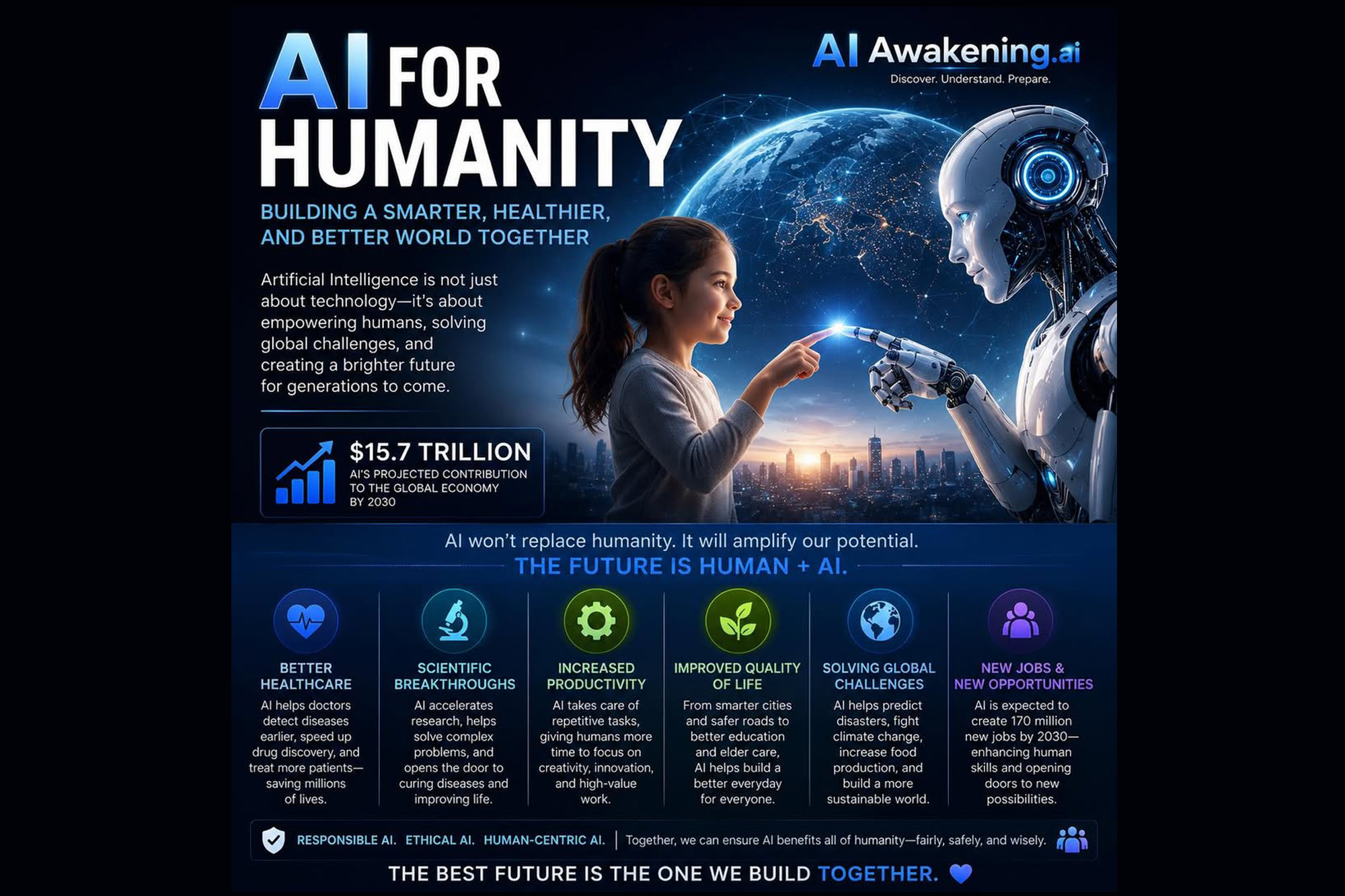
Human imagination still matters. Human leadership still matters. Human compassion still matters. AI does not replace the human spirit — it amplifies what humans are capable of creating when used responsibly.
The future will not belong to humans alone or machines alone.
It will belong to humans who learn how to work alongside intelligent technology wisely.
That is the real awakening taking place right now.
And most people do not even realize they are already part of it.