By Jonathan Edelman
Artificial Intelligence is no longer something people only saw in science fiction movies. What once seemed futuristic is now becoming part of everyday life. From smartphones and online shopping to medical research, transportation, customer service, and education, AI is rapidly changing how humans work, communicate, and solve problems. This moment in history is what many people are now calling the “AI Awakening.”
The AI Awakening represents a major turning point where artificial intelligence systems are becoming powerful enough to assist humans in ways never seen before. AI can now recognize images, understand language, create artwork, write code, generate videos, and help businesses operate more efficiently. These advances are happening at incredible speed, and the impact is being felt across almost every industry.
Some experts compare AI to historic breakthroughs such as electricity, the steam engine, or the internet. Those technologies changed the world forever by increasing productivity and creating entirely new industries. AI appears to be following a similar path. Instead of simply being another software tool, AI may become a foundational technology that reshapes how society functions over the next several decades.
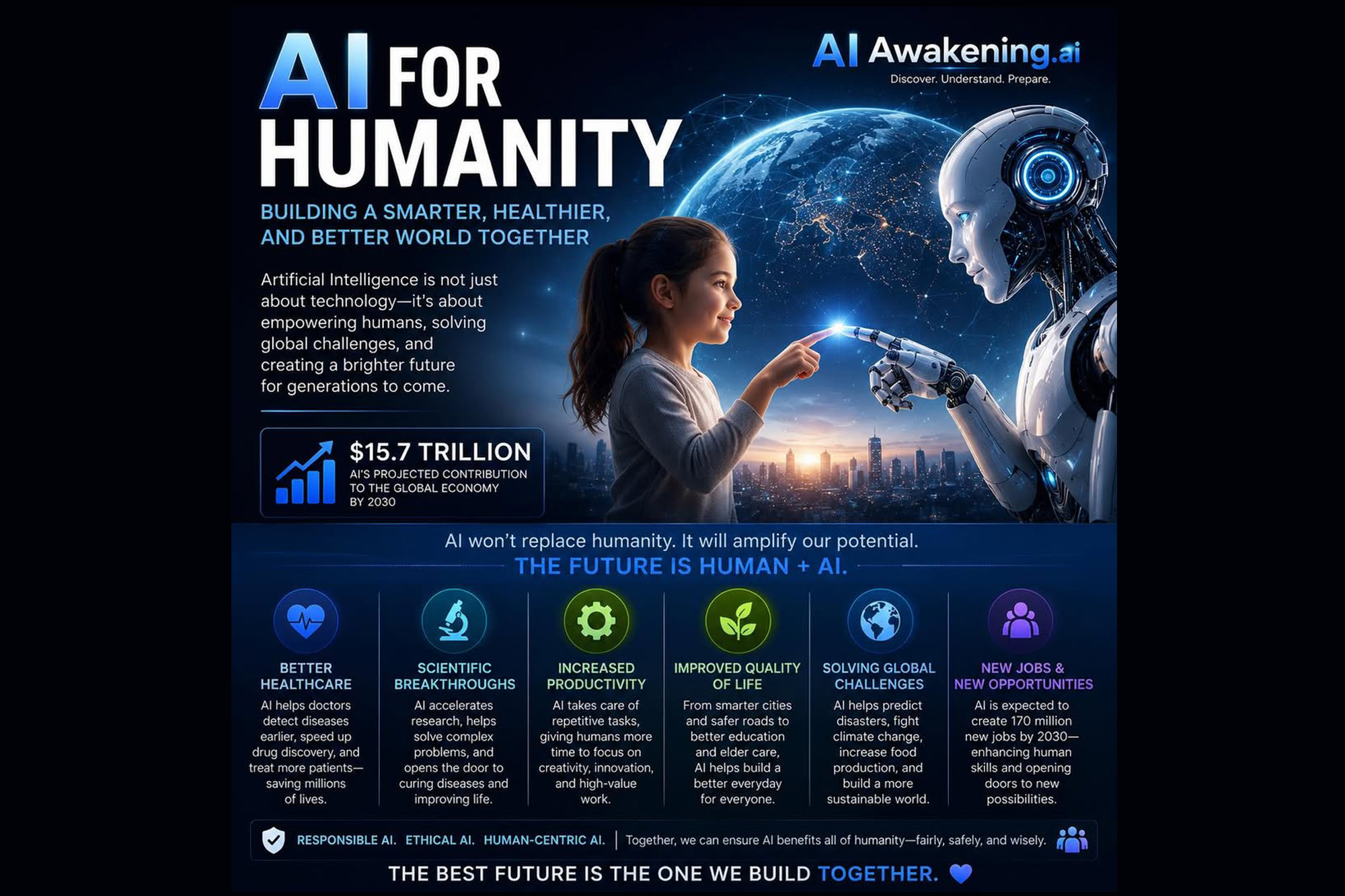
One of the most important ideas behind the AI Awakening is the concept of augmentation instead of replacement. Many people fear AI because they worry it will eliminate jobs and reduce human value. While certain tasks may become automated, AI also has the ability to help people become more productive, creative, and efficient. The future may not be humans competing against AI, but humans learning how to work alongside it.
A good example of this can already be seen in education and training. AI systems are beginning to act like real-time assistants and coaches. A new employee can now receive instant guidance, explanations, and suggestions that once required years of experience to learn. Small business owners can create professional graphics, videos, marketing campaigns, and written content without hiring massive teams. Students can receive personalized tutoring and support tailored to their learning style.
Another major shift involves generative AI. Unlike older systems that mainly analyzed information, modern AI can now create entirely new content. AI can generate articles, music, logos, images, presentations, software code, and even movie-style videos. This opens the door for ordinary people with ideas and creativity to build projects that once required large companies and expensive production teams.
At the same time, the AI Awakening raises important questions about ethics, responsibility, and the future of work. Technology this powerful must be guided carefully. Society will need to focus on building AI systems that help humanity instead of creating unnecessary harm or concentrating too much power into too few hands. Responsible development will matter just as much as innovation itself.
There is also a growing discussion about what some researchers call the “Turing Trap.” This idea warns against focusing only on building machines that imitate humans perfectly. If society only uses AI to replace people, it could damage economic opportunity and reduce the importance of human contribution. Instead, many experts believe the better path is creating AI tools that expand human abilities and help people achieve more together.
The truth is that humans have already trusted advanced technology for years. Modern airplanes use autopilot systems, hospitals rely on computer-guided equipment, and financial systems process millions of automated transactions every second. AI is simply becoming the next stage of this technological evolution.
The AI Awakening should not be viewed only through fear. It should also be viewed as an opportunity for learning, creativity, and growth. Like every major technological revolution in history, there will be challenges, adjustments, and new responsibilities. But there will also be enormous possibilities for people willing to adapt and learn.
The future will likely belong to those who understand how to combine human thinking, creativity, emotion, and experience with the growing capabilities of AI tools. The goal should not be replacing humanity. The goal should be helping humanity evolve alongside the technology it created.
Whether people are excited about AI or uncertain about its future, one thing is becoming increasingly clear: the AI Awakening has already begun.